

TechCoach and PREMIERE are humanizing the Multi-Actor Approach
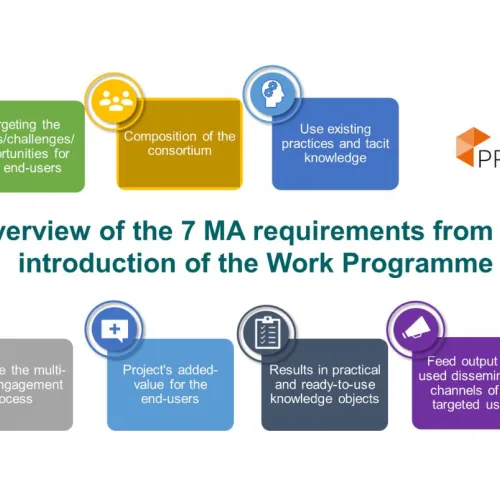
In the complex landscape of European agricultural innovation, two projects are joining forces to ensure that the Multi-Actor Approach (MAA) is more than just a checkbox on a grant application. While the PREMIERE project works at the foundational level to help project coordinators navigate the "official" and legal requirements of MAA in Horizon Europe proposals, the TechCoach project provides the practical testing ground where these principles come to life.
In a coming podcast episode, experts from both projects discuss how to move from official definitions to real-world impact. As Hanna Tamsalu, the AKIS manager in Estonia, noted, terms like AKIS (Agricultural Knowledge and Innovation Systems) can feel like "another bureaucratic term" to those on the ground. The goal of this collaboration is to ensure that the information reaching farmers is tailored for their needs.
TechCoach, solving the human side of technology adoption
The TechCoach project (https://www.techcoachproject.eu/) is a Horizon Europe-funded initiative spanning five countries: Finland, Greece, Hungary, Italy, and the Netherlands. Its primary mission is to strengthen the ability of farmers to assess and adopt smart farming technologies. However, as Gilbert Ludwig, senior researcher at Jamk University of Applied Sciences (https://www.jamk.fi/), explains, the barrier to technology is rarely just the tech itself.
"Solving tech adoption isn’t just about the tech itself. It’s about the people. It’s about working together and learning together to make the innovation stick in farming." Gilbert Ludwig.
To ensure this co-creation, TechCoach is built on a strict MAA obligation, connecting existing Operational Groups (under the EIP-Agri framework) with researchers and advisors to ensure solutions are grounded in on-farm reality.
One of the most critical distinctions in this collaborative approach is the difference between a "stakeholder" and an "actor." During the discussion, Hanna Tamsalu emphasized that the Multi-Actor Approach requires active, hands-on participation rather than passive consultation. This focus on active participation allows projects to tap into tacit knowledge - the generational, felt experience of farmers that cannot be found in scientific papers alone.
"Actor means that there is a person actively acting. Working there really hands-on and doing something important which has impact. A stakeholder means the person who you consult with occasionally." Hanna Tamsalu.
One of the most significant worries in European projects is the fear that once the project funding ends, the innovation will stall. Hanna Tamsalu highlights this as a major pitfall that must be addressed before a project even begins. Perhaps the most enduring impact is the trust and social bonding created during the process. Tamsalu notes that these social interactions live forward long after the project ends, as the participants carry their new networks and collaborative attitudes into future work.
Innovation Bootcamps
The core of the TechCoach methodology is the Innovation Bootcamp, a focused and intensive hands-on co-creation event designed to foster creativity and problem-solving. Gilbert Ludwig describes these bootcamps as a practice ground for collaboration, acting as "simulated multi-actor projects in miniature".
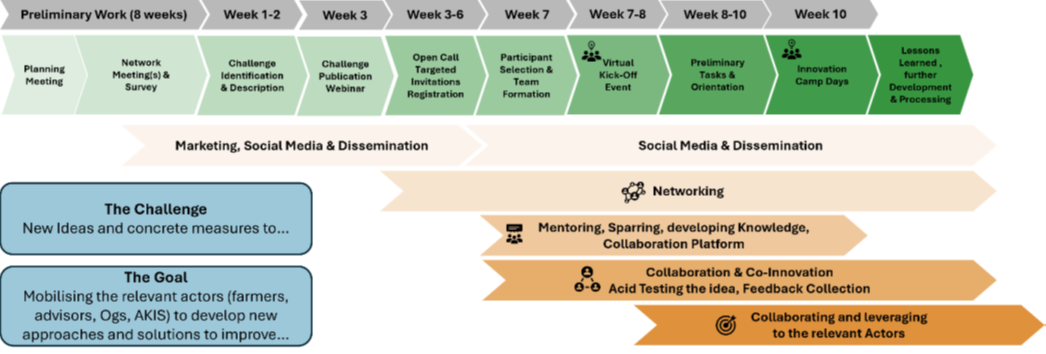
The bootcamp model is heavily inspired by the Bioboosters by Jamk hackathon model, sharing the same intensive, time-pressured environment where teams tackle challenges in a short timeframe, usually one or two days. However, unlike a traditional 24-hour hackathon where connections might fade once the clock stops, the TechCoach bootcamp is a 10-week journey. It involves two months of preliminary work to identify real-world farm challenges followed by a virtual kick-off where teams use digital platforms like Howspace to begin solving tasks together before ever meeting in person.
During the event itself, teams follow a structured schedule of ideation, design, and validation sessions. A defining feature is the use of mentor rotations, where domain experts circulate between groups to provide feedback, challenge assumptions, and offer new networking opportunities. This "pressure cooker" environment culminates in a grand finale pitching session, where each team has six minutes to present their novel idea to a jury of experts. To illustrate the journey of these bootcamps, the project utilizes a standardized process timeline (see Figure below). This 10-week cycle moves from initial networking and challenge identification through to a virtual kick-off, culminating in the intensive on-site bootcamp days and a final "lessons learned" phase.
This program ensures that facilitators are not just organizing events but are skilled in managing complex multi-actor dynamics and neutralizing power imbalances. The training includes a series of webinars and hands-on co-facilitation at pilot events where facilitators learn to use tools (like canvases and interaction rules) to ensure every voice carries equal weight.
From "Cold" Proposals to "Warm" Environments
The synergy between PREMIERE and TechCoach is where the "official" meets the "experiential." PREMIERE focuses on the official requirements of MAA mandated by the European Commission for Horizon Europe Cluster 6 projects. Hanna Tamsalu explains that while these requirements can seem "cold" or "boring" when viewed solely as a way to get a good score from evaluators, the practical experience of a bootcamp provides the necessary "warmth" to the process.
"In PREMIERE we are working to bring this cold wording into the warm environment. Like where these bootcamps happen... you really co-create new solutions." Hanna Tamsalu.
A true Multi-Actor Approach goes beyond just mixing minds; it requires active participation rather than passive consultation. The distinction between actor and stakeholder is vital for tapping into tacit knowledge - the generational, felt experience of farmers or other practitioners, that scientists cannot provide.
Furthermore, the warmth of this approach comes from active facilitation that flattens hierarchies and neutralizes power imbalances. In these living laboratories, facilitation techniques ensure that a farmer’s practical insight carries as much weight as a researcher’s scientific data. By including social infrastructure like joint meals or, in the Finnish pilot, even discussions in a sauna, the project builds the trust and social bonding necessary for innovation to actually grow in the farming community.
While bootcamps provide a burst of innovation, they are designed to complement, not replace, traditional extension services. The goal is to empower advisors to become innovation facilitators who can pick up the concepts developed during a bootcamp and help farmers implement them through regular channels like farmer field schools or demonstration projects. By documenting solutions in the EU FarmBook (https://eufarmbook.eu/) and presenting them to thematic networks like AgriHubi (https://maaseutuverkosto.fi/en/agrihubi/), the project ensures that grassroots innovations from the bootcamps inform higher-level policy and are accessible to the wider European agricultural community.
Stay Tuned to Listen
How do you "mix minds" across different roles to solve a global food crisis? How can a "Michelin Star" rating system for farms or a "luxury rental" platform for idle fields change the future of agriculture?
The full conversation, featuring deeper insights into the results of the Finnish pilot bootcamp and the future of agricultural advisory services, will be available soon. Stay tuned to listen to the full podcast episode and join the conversation on the future of co-innovation.